
PRESS RELEASE
Title: Climate Change: Study solves long-standing mystery of the cause of rising temperature.
Subtitle: Austrian physicist presents a precise calculation model for future global temperature trends.
Graz, June 12, 2026. A recently published research paper (available on the scientific platform Zenodo at https://doi.org/10.5281/zenodo. 20572759) by Graz-based physicist Radko Pavlovec establishes a connection between the development of the Earth’s Energy Imbalance (EEI) and the measured Global Surface Average Temperature (GSAT) on Earth. This new study resolves the long-standing puzzle surrounding the discrepancy between the 40% increase in the Earth’s Energy Imbalance (EEI) and the far smaller 14% increase in radiative forcing (ERF) caused by greenhouse gas emissions—a massive difference that was also addressed in the IGCC report published yesterday, but could not be explained there.
The results show that the temperature exhibits a quadratic term in its time dependence and that the linear relationship between cumulative CO2 emissions and temperature rise, which has been used for forecasts to date, can no longer be considered valid. The representative temperature function derived in the study allows for an accurate representation of past trends as well as a valid forecast of future temperature trends.
Analysis of EEI trends has shown that the decrease in Earth’s albedo (the Earth’s reflectivity) became the primary driver of global warming as early as 2000. Application of the temperature function shows that key temperature thresholds, such as the 2-degree Celsius limit, will be exceeded as early as 2034—significantly sooner than projected in the IPCC AR6 report (2047). As a result, current climate models must be revised accordingly. The massive acceleration of the temperature rise identified in the study requires both the fastest possible decarbonization and additional measures to increase albedo in order to stabilize the temperature.
“I noticed that actual temperature trends are diverging further and further from the IPCC projections (AR5 and AR6). This impression was confirmed when I systematically examined NASA’s measurements of the energy imbalance.
The significant ‘temperature jump’ in 2023, which has yet to be satisfactorily explained, led me to investigate the discrepancies. Some studies at the time already suggested an acceleration in the rate of temperature rise, while other scientists disputed this trend or viewed it as ‘within the scope of existing models.’ “I have come to the conclusion that the EEI must represent the fundamental parameter in the development of the mean temperature. Using the representative temperature function TCS determined in the study, the question of the acceleration of the temperature rise in the years 2023–2024—which has been the subject of studies and discussions in recent months—can be clearly answered,” said study author Pavlovec.
On the study „The mean temperature follows the development in the Earth’s Energy Imbalance and contains a quadratic term in its time dependence“
The extreme rise in the global surface average temperature (GSAT) during the years 2023–2024 sparked a lively debate over whether this represented a new trend or merely a random cluster of extreme values. In this publication, using measurement data from NASA’s CERES program (2000–2025), it is demonstrated that the temperature trend is not linear but
parabolic, as a consequence of the increasing proportion of self-reinforcing cycles associated with changes in Earth’s albedo.
During the period under study, the decrease in Earth’s albedo was the dominant driver of the temperature increase, with a radiative forcing (RF) value of 2.38 W/m². It exceeded the contribution of the radiative forcing caused by the increase in CO2 concentration (0.77 W/m²) by more than three times and is already greater than the CO2 forcing since the beginning of the Industrial Revolution (approximately 2.28 W/m² by the end of 2025).
A temperature function was derived from the Earth’s Energy Imbalance development and compared with the ERA5 GSAT measurements. It was found that the temperature measurements follow the EEI trend with a 10-month lag. Based on the results obtained, a representative temperature function was determined that accurately reflects the temporal evolution of the climate system (see Figure 1)
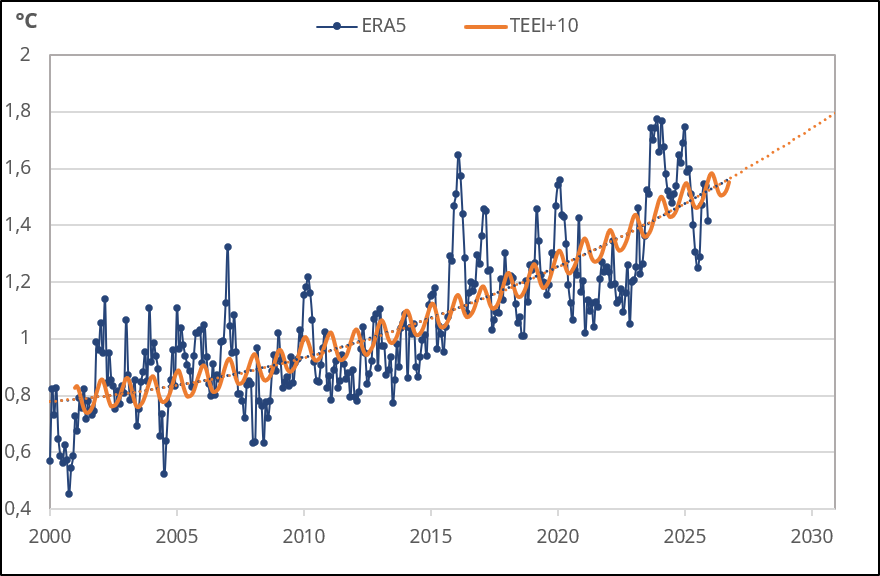
Figure 1
The temperature curve TEEI , shifted by 10 months, compared with the ERA5 temperature data. The trend line corresponds to the representative temperature function TCS of the climate system.
Using this temperature function, the rate of temperature increase was determined to be 0.17°C per decade for the period 2001–2010 and 0.40°C per decade for the period 2015–2024, thereby demonstrating a significant acceleration.
Determining when key temperature thresholds are exceeded using the representative temperature function (see Figure 2) results in a dramatic shortening of the relevant time periods compared to the method for determining CO2 budgets used to date, which was applied in the IPCC AR6 report.
According to this, the 1.5°C threshold was already exceeded in July 2025. The 2°C threshold will be exceeded in mid-2034, whereas based on the AR6 CO2 budget (assuming CO2 emissions remain constant at 2025 levels), this is not expected to occur until late 2047. Around this time, the temperature curve will already reach the 3°C threshold.
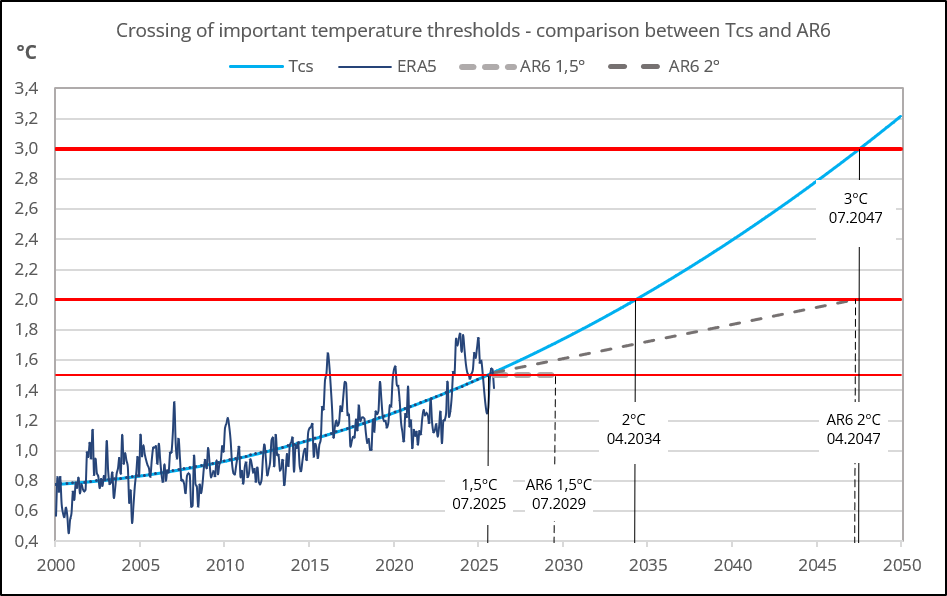
Figure 2
Timing of crossings of key temperature thresholds – comparison between the TCS temperature function and CO2 budgets according to AR6
These enormous differences are due to the use of a linear relationship between cumulative CO2 emissions and the rise in global average surface temperature that is no longer valid, as well as to the massive underestimation of albedo-related feedbacks, in AR6.
Download-Link fort he study:
The study „The mean temperature follows the development in the Earth’s Energy Imbalance and contains a quadratic term in its time dependence“ by Radko Pavlovec (June 2026) is available for download in English and German on the Zenodo research platform (open access):
https://doi.org/10.5281/zenodo.20572759
A global emergency plan is needed
As temperatures rose at an accelerated rate, there was a growing tendency to downplay or even outright deny the true extent of the anthropogenic greenhouse effect. The situation reached a peak with the United States’ withdrawal from the Paris Agreement.
“This new study and the application of the temperature function underscore the urgency of taking action to save the climate. The time available to implement measures aimed at preventing temperatures from rising to uncontrollable levels is being dramatically reduced. The situation requires both the fastest possible complete decarbonization as part of a global emergency plan and additional measures to increase albedo in order to stabilize temperatures,” Pavlovec concluded.
Radko Pavlovec
Radko Pavlovec, born in 1962 in the Czech Republic, studied Technical Physics at the Vienna University of Technology. He worked for various NGOs in the energy sector before serving as the Anti-Nuclear Representative for the State of Upper Austria from 1998 to 2010, during which time he led anti-nuclear activities in the Czech Republic and Slovakia. Through his company, PAVLOVEC ENERGY CONSULTING, he has been conducting systematic scientific research since 2012 in the field of climate stabilization and the causes of global warming. Since 2015 (the Paris Climate Agreement), this research has become his primary focus.
For further information:
Radko Pavlovec, m: +43 664 421 74 91, e: energy@pavlovec.com
Andrea Pavlovec-Meixner, ComCom-Netzwerk für Kommunikation
m: +43 664 264 20 35, e: pavlovec@comcom.co.at